The Career Graph: How Mapping Your Highs and Lows Reveals What You Actually Need at Work
By Debbie Gainsford | Career Coach for Marketers | March 2026
Debbie Gainsford is a career coach and global marketing leader with two decades of B2B marketing experience. She helps marketers at a crossroads get clear on what they want and build the confidence to go after it.
I did this exercise years ago. I sat down with a blank piece of paper, drew a simple line, and started plotting the moments that had made me feel most alive at work - and the ones that had quietly ground me down.
It sounds almost too simple to be useful.
But what happened surprised me. Patterns I hadn't consciously noticed suddenly became obvious. Things I thought I valued turned out to matter far less than I'd assumed. And a few things I'd been ignoring for years - the conditions that consistently made me miserable - were suddenly impossible to dismiss. Spoiler - I need natural light and a window to look out of, otherwise my performance drops.
It's one of the exercises that consistently unlocks something.
What Is a Career Graph?
A career graph is a simple visual tool for mapping your career satisfaction over time. You draw a timeline across the bottom - your whole career, a specific role, or any period you want to examine. On the vertical axis: satisfaction. Then you plot the line.
Not the job titles. Not the promotions. The actual experience of being there.
The line goes up when work felt energising, meaningful, stretching in the right way. It dips when it didn't.
The power isn't in the line itself. It's in what you write next to it — a few honest words about what made each high a high and each low a low.
And the scope is broader than most people expect. The things that move the line aren't always about the work itself. Commute length. Flexibility. Who you sat next to. Whether you felt trusted. How much travel the role demanded. All of it counts.
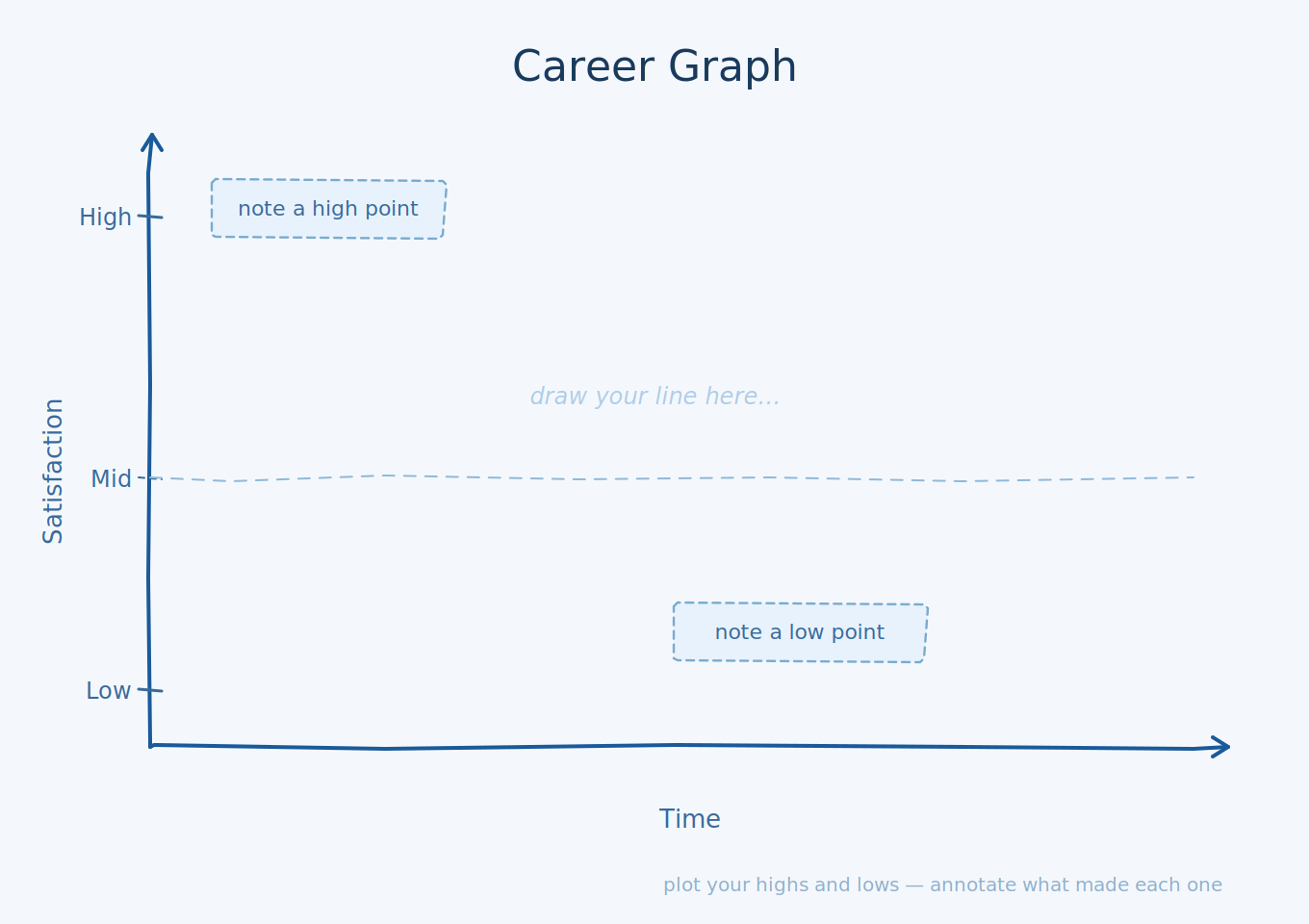
Career Graph Template
Why Marketers Find This Exercise So Useful
Most career reflection tools ask you to list. Your achievements. Your skills. Your strengths. Those things matter, and we'll come to them.
But a career graph asks you to feel your way through your career rather than analyse it from a distance. And when you do that, different things surface.
You might notice that your highest points weren't in your most impressive roles. They were in the roles where you had genuine autonomy, a team you trusted, or a problem worth solving. You might notice that the lows followed a pattern - a particular type of manager, a particular kind of environment, a mismatch between what you were asked to do and what you actually do well.
This is information a CV will never give you. It sits alongside your strengths, not instead of them, because knowing what you're good at is only half the picture. Knowing the conditions in which you do your best work is the other half.
How to Do the Career Graph Exercise
You don't need anything sophisticated. Paper, a notes app, a whiteboard. Whatever you'll actually use.
Step one: Choose your scope. You can map your entire career, or zoom into a single role or period. Both are useful and reveal different things. The full career map shows long-running patterns. The single-role map is helpful when you're trying to understand why a particular job worked or didn't, or when you're in something right now that feels off and you can't quite name why.
Step two: Draw the axes. Time along the bottom. Satisfaction on the vertical, no numbers needed, just a rough sense of high and low relative to your own experience.
Step three: Plot the line honestly. Don't curate it. The lows matter as much as the highs. Include the redundancy, the difficult manager, the role that looked great on paper and felt hollow in practice. Include the project that lit you up, the team you didn't want to leave, the moment someone trusted you with something significant.
Step four: Annotate. Next to each peak or trough, write a few words about what was actually happening. Be specific. "Good team" is less useful than "I had real autonomy and felt trusted to make decisions." "Bad role" is less useful than "I was micromanaged and the work felt pointless."
Step five: Look for the pattern. What do your highs have in common? What keeps showing up in the lows? Are there conditions - types of work, types of environments, types of relationships - that consistently move the line one way or the other?
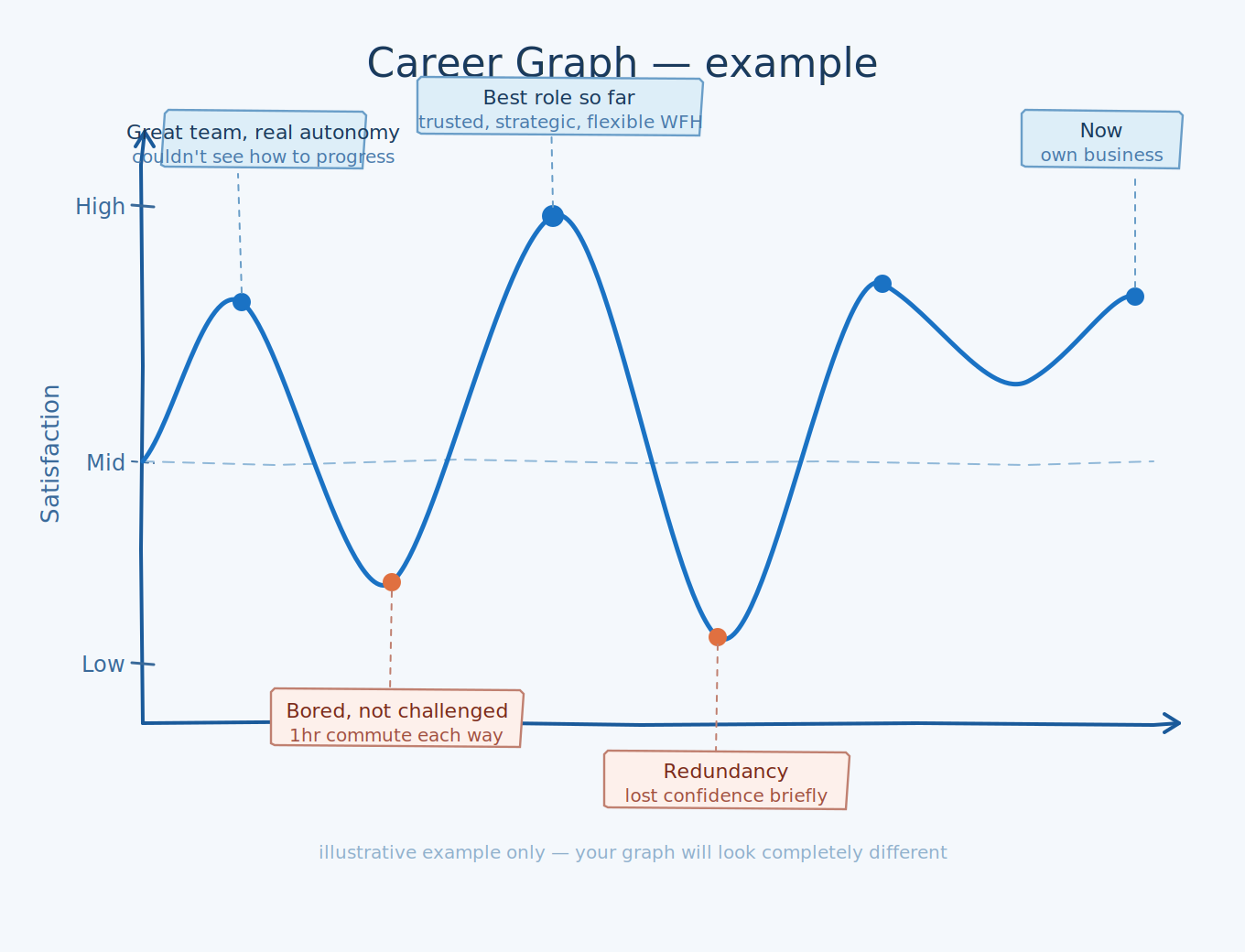
An example of a completed Career Graph - not mine - AI generated, thanks Claude
What Moves the Line (It's Not Always What You Think)
The themes that emerge from this exercise tend to go broader than people expect. Job titles and salary rarely drive the line. It's usually the stuff underneath.
The work itself. The types of problems you find energising versus draining. Some marketers come alive in the strategic, ambiguous early stages. Others thrive in execution. Some need variety; others need depth. The graph usually makes this visible quickly.
The environment. Not just company size or culture, the physical reality of the work. Where you were based, whether you were remote or in an office, how long the commute was. These things show up in the graph more than most people expect. They're worth paying attention to, not dismissing as superficial.
The relationships. Who you were working with, and how. The quality of your manager. Whether there was a team around you. Whether you felt respected and trusted. These factors show up in the highs and lows more often than almost anything else.
Autonomy. How much control you had over your work, your time, your approach. For many marketers this turns out to be one of the strongest predictors of satisfaction. When it's there, even hard work feels meaningful. When it's absent, even an interesting role can feel suffocating.
The practical conditions. Commute length, flexibility, travel demands, working hours. One of the most common things people notice is that a role they remember as a low was actually fine in terms of the work itself - it was the two-hour daily commute or the constant travel that eroded everything else.
What to Do With What You Find
The patterns aren't just interesting in retrospect. They're a filter for every decision that comes next.
When you're evaluating a new role, you're no longer just reading the job description. You're asking: does this environment match my highs? Does this role contain the conditions that have consistently made me miserable? Is there autonomy? Is there a team worth joining?
When you're in a role that feels off, the graph helps you diagnose what's actually wrong - which matters, because "this isn't working" is hard to act on. "I've lost autonomy and the commute is killing me" is something you can do something about.
And when you're building a career narrative - trying to explain the thread running through everything you've done - the graph often gives you language you didn't have before. Not just what you've done, but what you consistently need to do your best work. That's a story worth telling.
This Exercise Works at Any Career Stage
I've done it with marketers who are three years in and already questioning their direction. I've done it with people who are twenty years in and feeling stuck. The length of the line doesn't change how useful the exercise is.
What matters is the honesty you bring to it.
You don't need to have everything figured out before you start. The point of the graph is to help you figure it out. Sometimes you don't know what you actually value until you see it plotted out in front of you, and suddenly a decade of decisions starts to make a different kind of sense.
Book a free discovery call with Debbie →
Debbie Gainsford is a career coach and strategic advisor for marketers and founders, based in Sydney, Australia. She works with clients locally and globally.
Frequently Asked Questions About the Career Graph Exercise
What is a career graph and how does it work? A career graph is a visual tool for mapping your job satisfaction over time. You plot a line across your career - or a specific role - marking the highs and lows, then annotate what was happening at each point. The goal is to identify patterns in what consistently energises you and what consistently drains you.
How long does the career graph exercise take? A rough version takes around twenty minutes. A more honest, annotated version might take an hour, and some people find it useful to come back to it a day later with fresh eyes. There's no right amount of time. The value is in what you notice, not how quickly you finish it.
Can I do a career graph for just one job, not my whole career? Yes, and it can be just as useful. Mapping the arc of your experience within a single role - when you felt engaged versus when you started to disengage - can help you identify exactly what shifted and whether it's fixable.
What if my career graph is mostly low? That's important information. It's worth exploring whether the lows reflect the specific roles you've been in, the conditions you've been working under, or something broader. A persistently low graph isn't a verdict on you, it's usually a signal that something in the fit hasn't been right.
Do I need to share my career graph with anyone? No. This exercise is for you. The value is in what you notice privately, not in producing something polished. If you work with a coach, it can be a useful starting point for a conversation, but it works just as well as a solo exercise.
How is a career graph different from a CV or strengths assessment? A CV lists what you've done. A strengths assessment identifies what you're good at. A career graph reveals the conditions in which you thrive - which is a different and equally important question. The three tools complement each other well.